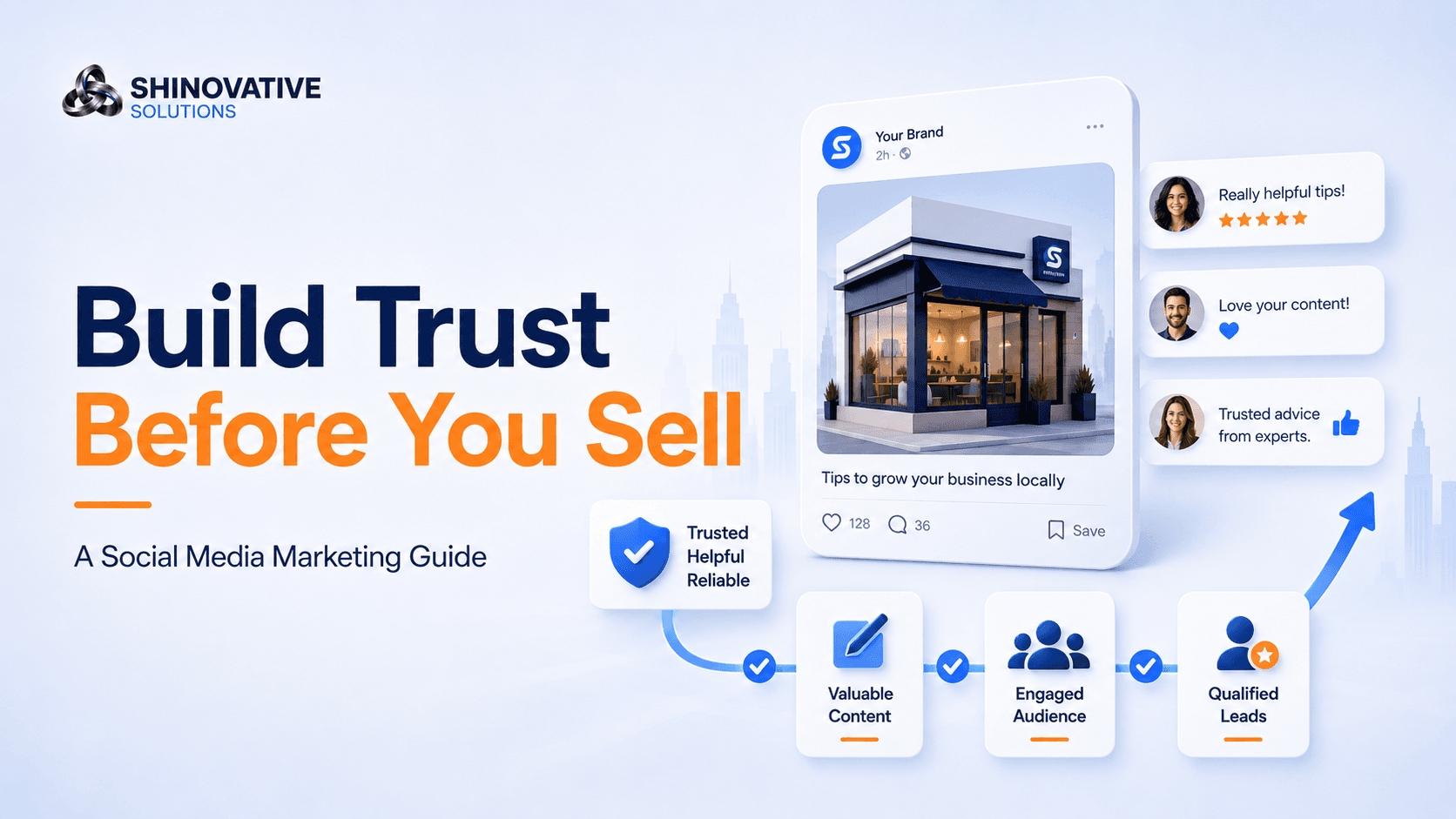
Social Media Marketing Guide: Build Trust Before You Sell
A customer discovers your business on Instagram.
They do not message immediately.
First, they check your profile. Then they scroll through your posts. They look at your designs, captions, comments, reviews, highlights, and whether the page feels active.
In less than a minute, they quietly decide:
“Does this business look trustworthy?”
That is the real role of social media marketing.
Many businesses think social media is only about posting offers or getting likes. But strong social media marketing does something deeper. It helps people become familiar with your brand before they are ready to buy.
People rarely buy from a business they do not understand or trust. Social media gives you a chance to build that trust slowly, consistently, and visibly.
What Is Social Media Marketing?
Social media marketing is the process of using platforms like Instagram, Facebook, LinkedIn, YouTube, and others to promote your business, educate your audience, build relationships, and generate leads or sales.
But it is not just posting every day.
Good social media marketing answers three questions:
- Who are we speaking to?
- What do they care about?
- What should they feel, learn, or do after seeing our content?
Without those answers, posting becomes random.
A business can post often and still get no results if the content does not connect with the audience.
The Trust-First Social Media Framework
A simple framework for business social media is:
Educate → Prove → Engage → Offer
This works better than only posting promotions.
1. Educate: Teach Something Useful
Educational content helps people understand their problem and your solution.
For example, a digital marketing agency can post about:
- Why a Google Business Profile is not ranking
- Common Google Ads budget leaks
- Website mistakes that reduce leads
- How Meta Ads retargeting works
- Why local SEO takes consistency
A fitness studio can post about workout habits. A cafe can post about ingredients, menu stories, or events. A clinic can post about symptoms, prevention, and treatment awareness.
Education builds authority.
When people learn from your content, they begin to see your business as helpful, not just promotional.
Example
Instead of posting:
We provide local SEO services.
Post:
If your business is not showing on Google Maps, check these three things first: business category, reviews, and service keywords.
That gives value immediately.
2. Prove: Show Why People Should Trust You
People need proof before they inquire.
Proof-based content can include:
- Customer testimonials
- Before-and-after results
- Case studies
- Work samples
- Behind-the-scenes process
- Team photos
- Client stories
- Screenshots of results
- Reviews
A business that only says “we are the best” sounds generic. A business that shows its process and results feels more credible.
Creative example
Imagine two agencies posting about website development.
Agency A posts:
We build beautiful websites.
Agency B posts:
Here is how we structure a service page: headline, problem section, services, proof, FAQs, and contact CTA.
Agency B teaches and proves expertise at the same time.
That kind of content builds trust.
3. Engage: Start Conversations, Not Just Broadcasts
Social media should not feel like a notice board.
A business page should invite conversation.
Engagement content can include:
- Polls
- Questions
- This-or-that posts
- Myth vs fact posts
- Comment prompts
- Short opinions
- Behind-the-scenes updates
- Customer stories
For example:
What is harder for your business right now: getting website traffic or converting visitors into leads?
That question encourages business owners to think and respond.
Engagement helps you understand your audience better. It also makes your page feel alive.
4. Offer: Sell Clearly, But Not Constantly
Selling is not bad. Businesses need to sell.
The problem is when every post feels like a pitch.
A good social media strategy mixes value and offers. After educating, proving, and engaging, you can invite people to take action.
Offer posts can include:
- Free audit
- Consultation
- Limited package
- Service launch
- Seasonal campaign
- Webinar
- Downloadable checklist
- Booking reminder
Example:
Want to know why your website is getting visitors but not leads? Request a free digital growth audit from Shineovative Solutions.
This works better when the audience has already seen your helpful content and proof.
Content Pillars for Business Social Media
Content pillars are categories that guide what you post.
For Shineovative, strong content pillars could be:
| Pillar | Example Content |
|---|---|
| Education | SEO tips, ad mistakes, website improvement tips |
| Proof | Client wins, audits, before-and-after improvements |
| Process | How campaigns are planned, how audits work |
| Offers | Free audit, consultation, service packages |
| Brand Story | Founder thoughts, team updates, values |
| FAQs | Answers to common business owner questions |
These pillars prevent random posting and keep the content balanced.
The 70-20-10 Rule
A simple posting balance:
70% value Educational, helpful, problem-solving content.
20% trust Proof, testimonials, process, behind-the-scenes.
10% promotion Offers, consultations, service posts.
This keeps your page useful without becoming too sales-heavy.
You can adjust the ratio, but the idea is important: do not sell before building trust.
Quick Social Media Marketing Checklist
Before posting, ask:
- Does this post help the audience?
- Is the message clear in the first few seconds?
- Is the design easy to read on mobile?
- Does it match the brand style?
- Is there a clear caption?
- Does it build education, proof, engagement, or offer?
- Is the CTA natural?
- Does the content connect to business goals?
A post should not exist only because “we need to post today.”
Every post should have a purpose.
Common Social Media Mistakes
1. Posting only festival greetings and offers
These posts are fine occasionally, but they do not build deep trust.
2. Copying trends without strategy
Trends can bring attention, but they should still connect to your brand.
3. Using cluttered designs
If people cannot read the post quickly, they scroll away.
4. Ignoring comments and messages
Social media is a communication channel, not just a display board.
5. Measuring only likes
A post with fewer likes can still bring better leads if it reaches the right people.
Final Takeaway
Social media marketing works best when it builds trust before asking for a sale.
Teach your audience. Show proof. Start conversations. Make clear offers.
When people repeatedly see helpful, consistent, and professional content from your business, they begin to remember you. When they need your service, your brand is already familiar.
That is the real value of social media.
It keeps your business visible before the buying moment arrives.
FAQs
What is social media marketing?
Social media marketing is the use of platforms like Instagram, Facebook, LinkedIn, and YouTube to build visibility, trust, engagement, leads, and sales for a business.
How often should a business post on social media?
Consistency matters more than posting every day. A business can start with three to four useful posts per week and improve based on audience response.
What type of content works best for businesses?
Educational posts, proof-based content, customer stories, FAQs, behind-the-scenes content, and clear offers usually work well.
Is social media marketing enough to get leads?
Social media can help generate leads, but it works better when connected to a strong website, clear offer, landing page, ads, and follow-up system.
Should small businesses use Instagram or Facebook?
It depends on the audience. Visual and consumer-focused businesses often do well on Instagram. Local communities and older audience segments may still respond well on Facebook.
Internal Link Suggestions
Link this blog to:
- Social Media Management Services page
- Meta Ads Services page
- Digital Marketing Strategy blog
- Website Development Services page
- AI Automation Services page
- Contact page
Suggested anchor text:
- social media management
- Meta Ads services
- digital marketing strategy
- website development
- AI automation for follow-up
- social media growth audit
Soft CTA
If your social media page is active but not helping your business grow, the issue may be lack of strategy, content pillars, proof, or follow-up.
Shineovative Solutions can help you build a social media marketing plan that makes your brand look professional, builds trust, and supports real business goals.