Rank #1 on Google: How Local Businesses Can Get Into the Top Search Results
Picture this.
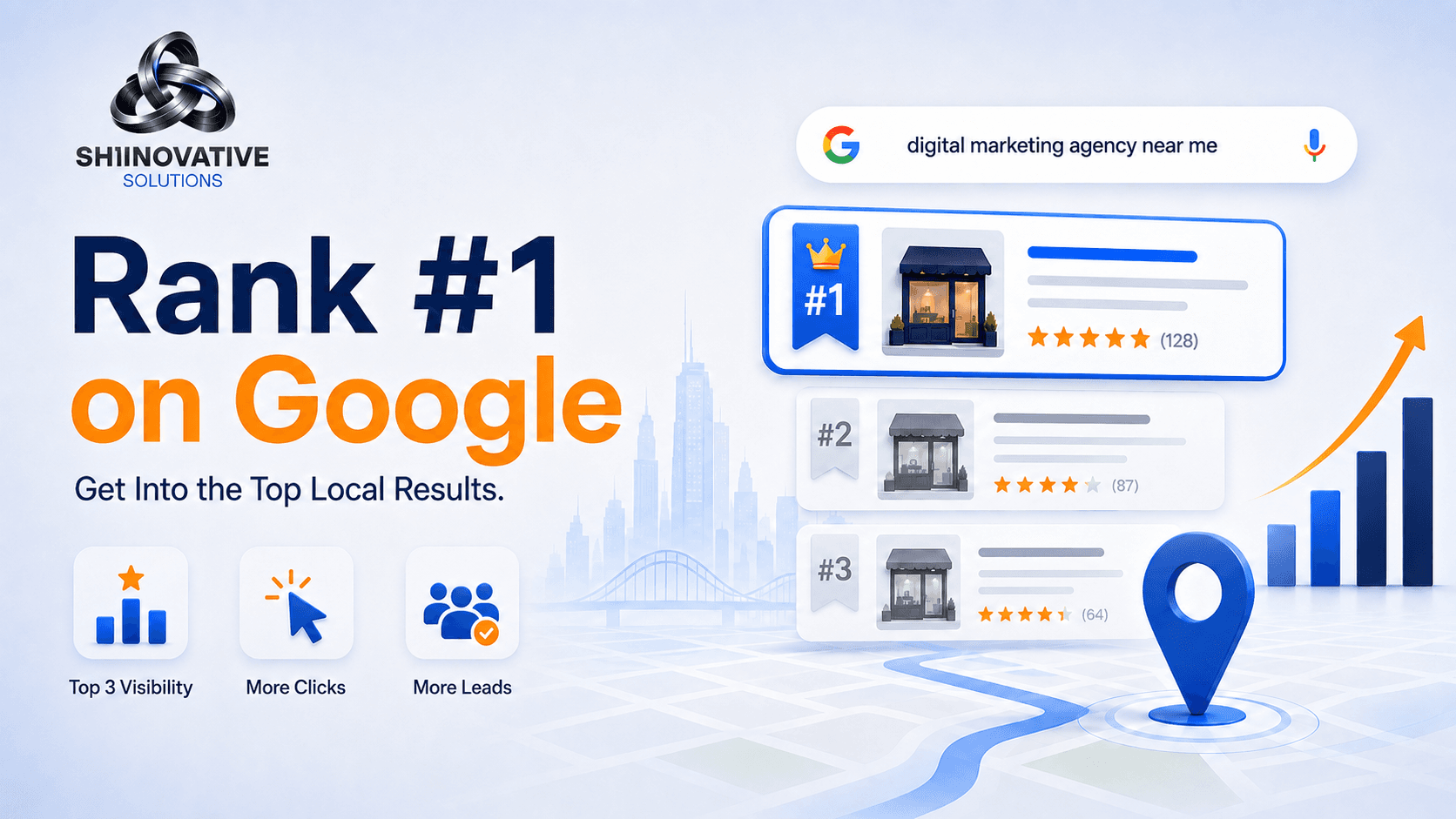
A customer opens Google and searches “best service near me.” They see three businesses at the top. One has strong reviews, clean photos, clear services, and a professional website. The second looks decent. The third has basic details.
Your business may be better than all three.
But if you are not visible there, the customer may never know.
That is why ranking on Google matters. It is not about ego. It is about attention, trust, and timing. The top results get more clicks because people naturally trust what Google shows first.
But here is the important part:
Ranking #1 on Google is not one single trick. It is the result of multiple trust signals working together.
For local businesses, those signals usually come from your Google Business Profile, website, reviews, local keywords, content, and consistency.
First, What Does “Rank #1 on Google” Actually Mean?
When people say they want to rank #1 on Google, they may mean different things.
For a local business, there are usually three important ranking areas:
Google Maps / Local Pack This is the map section that shows nearby businesses.
Organic search results These are the normal website results below or around the map section.
Paid ads These are sponsored results that appear when businesses run Google Ads.
Local SEO mainly focuses on the first two: Google Maps rankings and organic rankings.
If you run a salon, clinic, agency, restaurant, repair service, or local store, appearing in the top map results can be extremely valuable because customers can call, visit, check directions, and compare reviews directly from Google.
The Simple Ranking Formula
Google does not rank businesses randomly. For local searches, it tries to answer three questions:
1. Is this business relevant?
Does your business match what the customer searched?
For example, if someone searches “Google Ads agency near me,” Google needs to understand that your business actually provides Google Ads services.
That is why your business categories, services, website pages, and content matter.
2. Is this business nearby or serving this area?
Google considers location and service area. A business closer to the searcher often has an advantage, but that does not mean distance is the only factor.
A better-optimized business slightly farther away can sometimes outrank a poorly optimized nearby competitor.
3. Is this business trustworthy?
Trust signals include reviews, ratings, photos, website quality, backlinks, citations, brand mentions, and customer engagement.
The more complete and credible your presence looks, the easier it becomes for both Google and customers to trust you.
Example: The Invisible Best Business
Imagine two interior design companies.
Company A has excellent work but a weak Google profile. No recent photos. Few reviews. One basic services page. No local keywords. No project examples.
Company B has good work, but also has a complete Google profile, fresh project photos, detailed service pages, customer reviews, and blogs answering common questions like “how to choose an interior designer for a small apartment.”
Who is Google more likely to understand?
Company B.
Who is a customer more likely to trust?
Again, Company B.
This is why ranking is not only about being the best. It is about making your value visible.
Step 1: Make Your Google Business Profile Clear and Complete
Your Google Business Profile is the foundation of local ranking.
A weak profile makes it harder to rank, even if your website is good.
Make sure your profile includes:
- Correct business name
- Correct phone number
- Website link
- Accurate address or service area
- Proper primary category
- Relevant secondary categories
- Clear services
- Business hours
- Photos
- Reviews
- Business description
The biggest mistake is being vague.
Do not just say:
We provide marketing services.
Say clearly what you do:
Shineovative Solutions helps businesses grow through local SEO, Google Ads, Meta Ads, website development, e-commerce solutions, AI automation, and social media management.
Clear services help Google understand your business better.
Step 2: Build Pages for the Searches You Want to Rank For
You cannot rank for everything from one page.
If your website only has one general services page, Google has limited information about each service.
Create focused pages for important services.
For example:
- Local SEO Services
- Google Ads Services
- Meta Ads Services
- Website Development Services
- E-Commerce Development
- AI Business Automation
- Social Media Management
Each page should explain:
- What the service is
- Who it is for
- Problems it solves
- Your process
- Expected outcomes
- FAQs
- Contact option
This gives Google a stronger reason to show your website for specific searches.
Step 3: Use Search Terms Customers Actually Use
Business owners often describe services differently from customers.
A business may say:
Performance marketing solutions.
But the customer searches:
Google Ads agency near me Facebook ads for small business local SEO service website developer near me
Use language your customers use.
That does not mean stuffing keywords. It means writing clearly in customer-friendly terms.
Example:
Instead of:
We help brands scale digitally through omnichannel performance frameworks.
Write:
We help local businesses get more calls, leads, and website inquiries through Google Ads, local SEO, Meta Ads, and conversion-focused websites.
The second one is easier to understand and more useful for search.
Step 4: Collect Reviews That Tell a Story
Reviews help customers make decisions quickly.
But detailed reviews are more powerful than short reviews.
A review like this is okay:
Great service.
A review like this is better:
Shineovative helped us improve our local SEO and Google Business Profile. We started getting more inquiries from nearby customers and understood what was missing from our online presence.
The second review gives context. It tells future customers what problem was solved.
Ask happy customers to mention:
- What service they used
- What problem they had
- How the experience was
- What improved after working with you
Never fake reviews. Real trust always performs better in the long run.
Step 5: Add Proof to Your Website
Google rankings are not only about technical SEO. Your website also needs proof.
Add proof elements such as:
- Testimonials
- Case studies
- Before-and-after examples
- Client industries served
- Project screenshots
- Result summaries
- FAQs
- Clear service process
For example, if you provide local SEO, show what your audit includes. If you provide Google Ads, explain how you track leads. If you build websites, show how your websites help with speed, mobile experience, and conversions.
People trust specifics more than big claims.
Instead of saying:
We deliver best results.
Say:
We review your Google Business Profile, service pages, reviews, local keywords, competitor rankings, and conversion paths before building a local SEO plan.
That sounds more real and professional.
Step 6: Keep Your Business Information Consistent
Google checks your business information across the internet.
Your name, phone number, website, and address should be consistent on:
- Google Business Profile
- Website
- Social media pages
- Local directories
- Review platforms
- Business listing sites
If your information is inconsistent, it can create confusion.
For example, if one platform says “Shineovative Solutions” and another says “Shineovative Digital,” Google may treat them as different or unclear signals.
Consistency builds confidence.
Step 7: Track What Actually Matters
Getting to the top of Google is useful only if it brings business results.
Track:
- Phone calls
- Website visits
- Form submissions
- WhatsApp clicks
- Direction requests
- Keyword ranking movement
- Review growth
- Lead quality
A ranking report is helpful, but it is not the full picture.
The real question is:
Are more customers finding and contacting your business?
That is the goal.
Quick Action Plan to Improve Google Ranking
Here is a simple starting plan:
This week
- Update your Google Business Profile.
- Add missing services.
- Upload fresh photos.
- Check your business category.
- Reply to recent reviews.
This month
- Create or improve one focused service page.
- Add local keywords naturally.
- Ask happy customers for reviews.
- Add testimonials to your website.
- Fix inconsistent business details online.
Ongoing
- Publish useful content.
- Track calls and inquiries.
- Keep your profile active.
- Improve weak pages.
- Monitor competitors.
Small consistent improvements are better than one-time SEO work.
Common Mistakes That Stop Businesses From Ranking
1. Trying to rank without a complete Google profile
An incomplete profile weakens local visibility.
2. Using generic website content
If your website does not clearly explain your services, Google and customers both struggle.
3. Ignoring reviews
Reviews are one of the fastest ways to build trust.
4. Having no local content
Helpful local content gives Google more context about your services and market.
5. Expecting instant results
SEO takes consistency. You can improve quickly in some areas, but strong ranking usually builds over time.
Final Takeaway
Ranking #1 on Google is not about tricking the algorithm.
It is about making your business easy to understand, easy to trust, and easy to contact.
When your Google profile, website, reviews, service pages, local keywords, and customer proof all work together, your chances of ranking higher improve naturally.
The businesses that win local search are not always the biggest. They are often the clearest, most trusted, and most consistent.
FAQs
Can any business rank #1 on Google?
Any business can improve its ranking, but ranking #1 depends on competition, location, website quality, reviews, profile strength, and SEO consistency.
How long does it take to rank higher on Google?
Some improvements can happen in weeks, but stronger results often take a few months. Competitive industries usually take longer.
Is Google Business Profile enough to rank?
No. It is important, but your website, reviews, local content, citations, and overall trust signals also matter.
What is the top 3 on Google?
For local searches, the top 3 usually refers to the three businesses shown in the Google Maps local pack. These results often get strong visibility and customer actions.
Do Google reviews help ranking?
Yes, reviews can support trust and visibility. Detailed, genuine reviews are especially helpful for customer confidence.
Internal Link Suggestions
Link this blog to:
- Local SEO Services page
- Local SEO Checklist blog
- Google Ads Services page
- Website Development Services page
- Contact page
Suggested anchor text:
- local SEO services
- local SEO checklist
- Google Business Profile optimization
- website development for local businesses
- Google Ads for local leads
Soft CTA
Want to understand why your business is not showing in the top Google results?
Shineovative Solutions can audit your Google Business Profile, website pages, local keywords, reviews, and competitor visibility to identify what is holding your ranking back and what can be improved first.